- Your Next DoorDash Driver Might Have LED Eyes
- What Exactly Is DoorDash Dot?
- Where DoorDash Is Rolling Out Its Robot Delivery Service
- How the Dot Delivery Robot Actually Works
- Are Robots Taking DoorDash Jobs?
- Is Your Food Safe With an Autonomous Delivery Robot?
- Meanwhile at Kroger: A Whole Different Robot Army
- Could Kroger Use Dot-Style Upright Robots Too?
- DoorDash Dot vs. Kroger Autonomous Delivery: Side by Side
- The Bigger Play: Multimodal, All-AI Delivery Networks
- What This Means for Your Next Order
- Final Take: Don\’t Freak Out If Your Driver Has LED Eyes
DoorDash’s New Delivery Robot Dot: How It Works, Where It’s Launching, and What It Delivers.
Your next DoorDash driver might not knock, text you from the parking lot, or ask you to “meet at the door.” Instead, your food could roll up on four wheels, blink a pair of glowing digital eyes, and pop its robot mouth open so you can pull out your fries like you are feeding a very punctual, very futuristic vending machine.
That is not a fever dream. That is Dot — DoorDash’s brand-new in-house autonomous delivery robot, and the most headline-grabbing piece of DoorDash technology the company has ever built. The DoorDash Dot delivery robot is a bright red, roughly 350-pound all-electric autonomous vehicle built by DoorDash Labs. It can cruise neighborhood streets and bike lanes at up to 20 miles per hour, carrying your food in a locked, sealed cargo compartment until it reaches your door.
This new robot delivery service represents a major shift in how DoorDash thinks about logistics — moving from drone partnerships and sidewalk bots built by outside companies to fully in-house autonomous hardware. Between the splashy launch announcement, real-world pilots already running in Phoenix and Fremont, and a national TV tour that screamed “we are serious about this,”
DoorDash is sending the clearest signal yet: autonomous delivery is not a pilot program novelty anymore. It is the next chapter of how your dinner gets to your door. And behind the cute design sits the question everyone from Dashers to grocery chains to gig-economy analysts is asking: is Dot a sidekick for human drivers, or is this the beginning of the end of human-powered local delivery?
What Exactly Is DoorDash Dot?
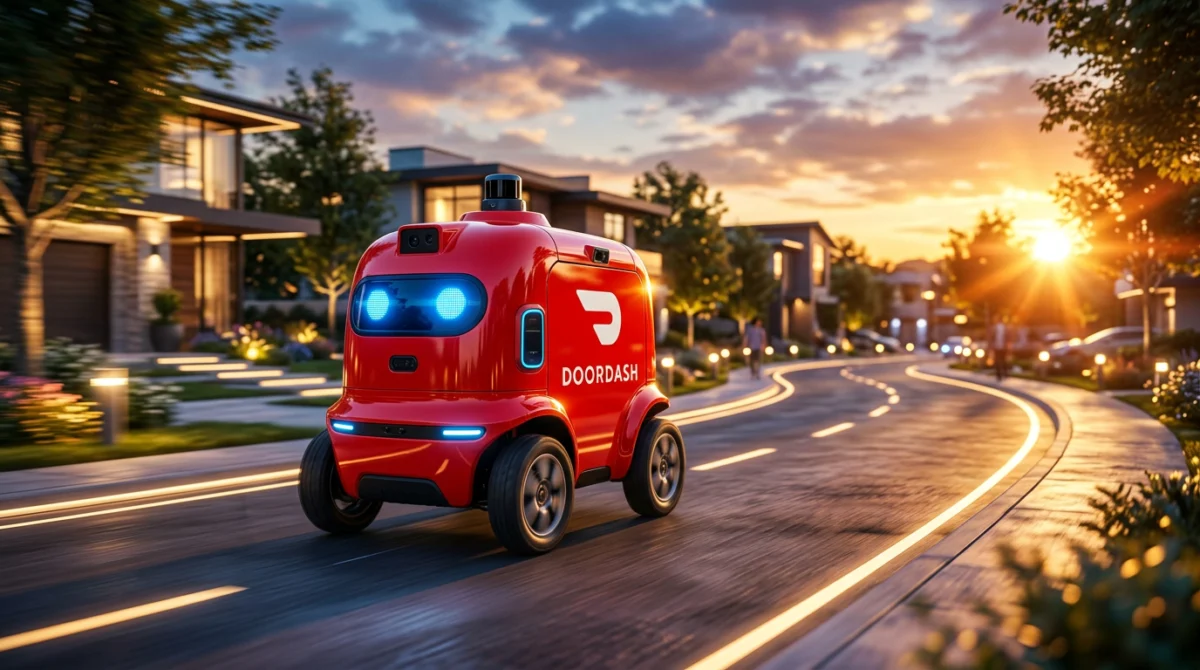
The robot’s cargo compartment locks from the moment the restaurant closes it to the moment the customer unlocks it at delivery — a meaningful upgrade over the traditional “bag left on porch while you were in the bathroom” method.
DoorDash says Dot’s entire design is derived from analyzing billions of completed deliveries on its platform — studying how far orders actually travel, how quickly food quality degrades in transit, where drivers lose time, and which short trips carry so little margin that human drivers are essentially working for free.
The result is a robot delivery service built on data: the smallest, most efficient autonomous machine that can still reliably complete a real neighborhood delivery at scale. Where DoorDash Is Rolling Out Its Robot Delivery Service. If you are already scanning your driveway camera for a blinking red robot, you might need to check which city you live in first.
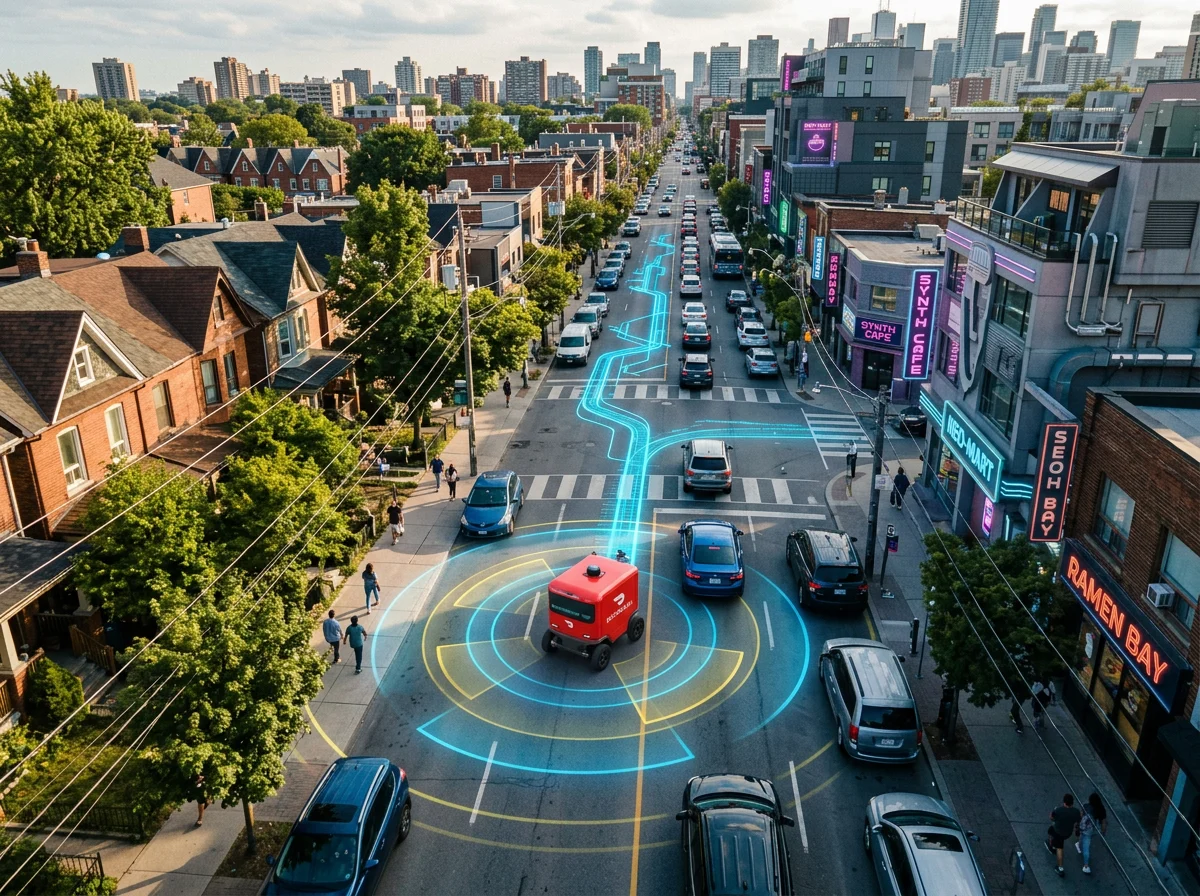
DoorDash is not carpet-bombing every market with Dot overnight. It is following the time-tested tech-company playbook: high-visibility pilots in hand-picked markets, maximum press coverage, and a deliberately slow expansion that lets the company collect autonomous delivery data, respond to issues, and build public comfort before it scales.
The greater Phoenix metro area is the flagship launch zone for this new robot delivery service, with pilots already active in neighborhoods across Tempe and Mesa. DoorDash has spoken about ambitions to serve well over a million residents in the region as the fleet grows — a statement that doubles as both a logistics goal and a very loud PR move.
The Phoenix market provides a useful cocktail of suburban streets, high restaurant density, and relatively flat, predictable terrain that suits DoorDash technology built for neighborhood-scale autonomous delivery runs.
On the West Coast, DoorDash formalized a collaboration with the City of Fremont, California, deploying Dot for merchant deliveries during local Restaurant Week — a clever partnership that gave both the city and local businesses a chance to showcase the robot delivery service while generating positive community press.Beyond the geography,
DoorDash has made sure Dot shows up on national television, in glossy product videos, and across every major tech and business outlet. Bloomberg covered the hardware debut, CNBC called it a push into autonomous technology, and DoorDash’s own Dot product page frames the robot as a preview of where the entire autonomous delivery industry is heading. These rollouts are as much a public confidence campaign as they are logistics experiments — and so far, the strategy is working.
How the Dot Delivery Robot Actually Works
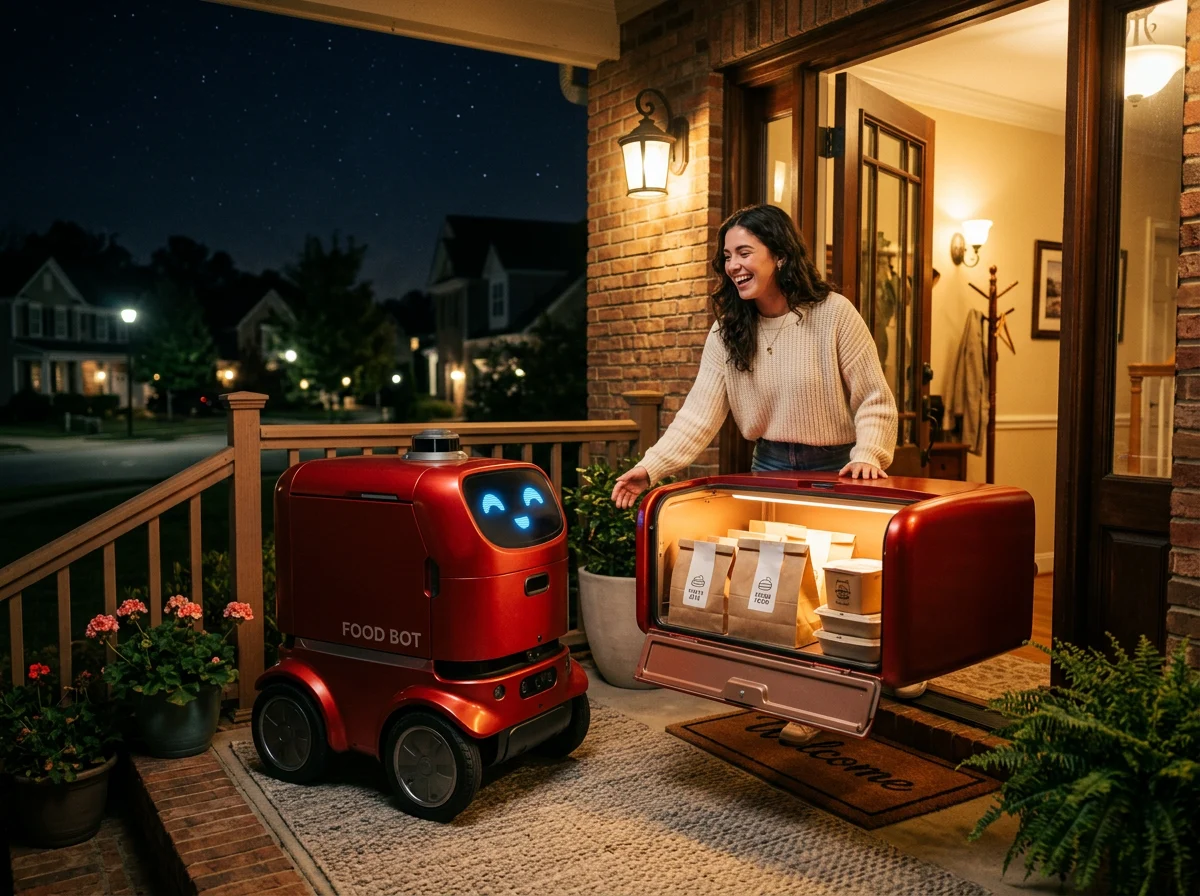
Once Dot is assigned the order, the restaurant or merchant loads food into its sealed cargo bay, locks it, and sends the robot on its way. Dot navigates its route using the combination of cameras, radar, and lidar that helps it identify and avoid obstacles in real time — cars pulling out, pedestrians stepping off curbs, delivery trucks blocking bike lanes.Customers track Dot in the familiar DoorDash app interface, and when it arrives, they unlock the compartment using an on-screen action or one-time code and retrieve their food directly.
The whole robot delivery service experience is engineered to feel like a normal delivery — just with four wheels, LED eyes, and zero small talk. Battery systems are designed for fast swaps to keep fleet uptime high, and remote human operators monitor multiple robots simultaneously, ready to step in if Dot encounters a situation its AI cannot confidently handle alone.
Are Robots Taking DoorDash Jobs?
The company also argues that by making its overall delivery network more efficient and affordable through autonomous delivery, order volume increases across the board, which creates more opportunities for everyone on the platform.
The broader trend DoorDash is pushing here is a hybrid model — human delivery and autonomous delivery working side by side to expand access to local commerce for more people.Whether that narrative holds up as robot fleets grow and DoorDash technology costs fall is a question the industry will be debating for years. But for now, DoorDash is betting heavily on the “and” rather than the “or” — insisting this is about growing the pie, not slicing it differently.
Is Your Food Safe With an Autonomous Delivery Robot?
One of the first concerns people raise about any robot delivery service is whether the food itself stays safe, fresh, and tamper-free during a robot trip.
DoorDash has built several physical safeguards into Dot to address this head-on. The cargo compartment is fully sealed and locked from the moment a restaurant loads the order to the moment the customer unlocks it through the DoorDash app.
There is no opportunity for tampering, theft, or accidental opening during transit — which is arguably more secure than a paper bag sitting in the back seat of a Dasher’s car. The compartment is insulated, which helps maintain food temperature over the short distances Dot is designed to cover.
Because the autonomous delivery robot targets local neighborhood deliveries within a tight radius, transit times are kept short enough to preserve food quality — one of the core problems DoorDash identified when analyzing billions of past deliveries.
The combination of sealed, locked insulation and short trip distances is a piece of DoorDash technology designed to keep your meal arriving in the condition it left the restaurant. On the road safety front, Dot’s sensor suite — cameras, lidar, and radar — gives it 360-degree situational awareness around the clock.
The robot is designed to stop or reroute automatically if it encounters obstacles, pedestrians, or hazards it cannot navigate safely. And if anything goes wrong that the AI cannot handle, remote human operators are watching in real time, ready to intervene. A local field operations team is also available for issues that require physical intervention.
DoorDash has also been transparent about privacy: Dot does not use facial recognition, no driving data is connected to any customer or passerby, and sensor data is never shared with partners. That kind of transparency is critical for any robot delivery service operating in residential neighborhoods where people are naturally cautious about cameras rolling past their homes.
Meanwhile at Kroger: A Whole Different Robot Army
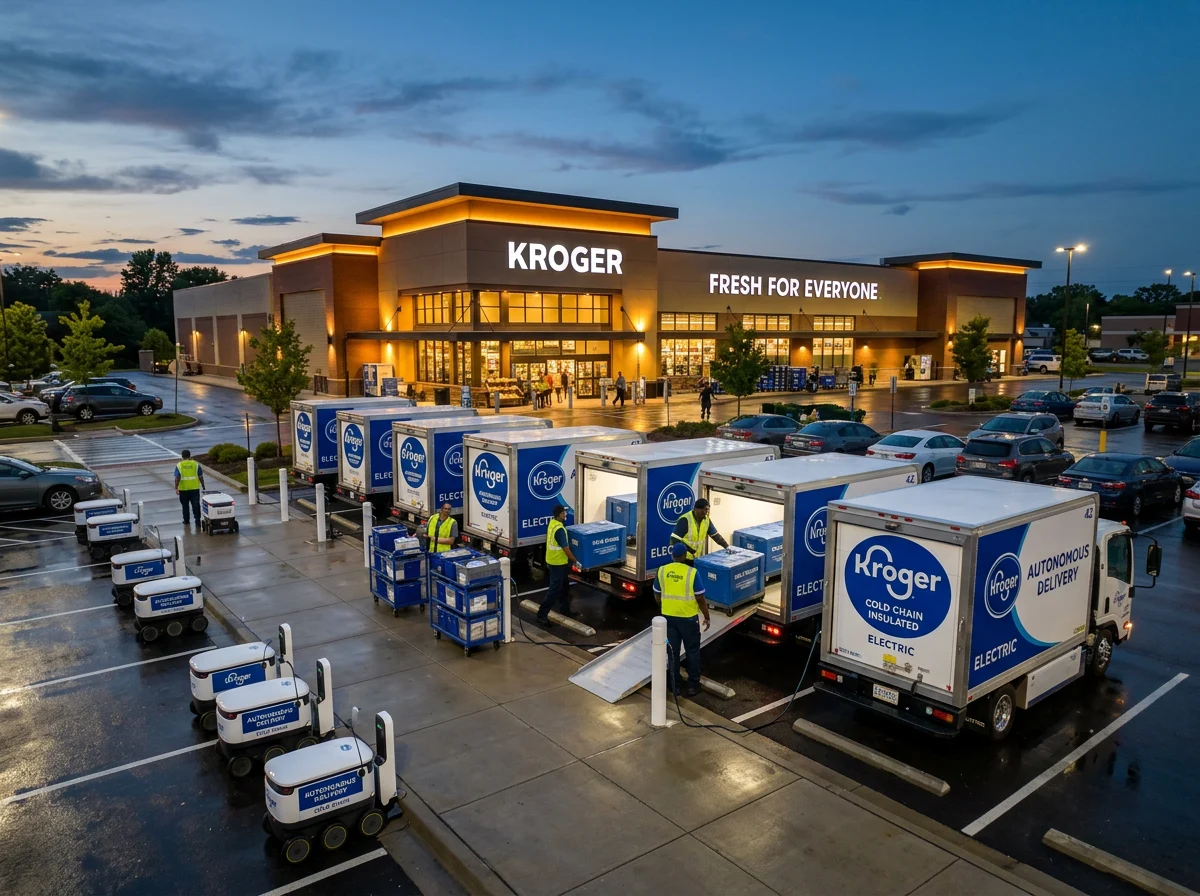
DoorDash is not the only major player investing in autonomous delivery. Grocery giant Kroger has been building its own autonomous delivery infrastructure for years — though the approach looks very different from the DoorDash technology stack powering Dot.
Rather than building a robot in-house, Kroger has partnered with outside technology companies to develop and test unmanned delivery vehicles specifically designed for grocery runs.Kroger’s most prominent autonomous delivery partner has deployed low-profile pod-style vehicles — very different from Dot’s upright, humanoid-adjacent form factor.
These vehicles are built to travel on public roads, carry larger grocery payloads with temperature-controlled compartments, and handle the heavier, bulkier deliveries that come with a full weekly grocery shop. Kroger has invested heavily in robotic fulfillment centers as well, using automated warehouse systems to pick and pack orders before handing them off to its autonomous delivery vehicles for last-mile runs.
The key difference in philosophy is integration. Kroger’s delivery robots are part of a broader ecosystem that includes robotic warehouses, drone partnerships, and traditional delivery infrastructure — but the delivery vehicles themselves are built and operated by third-party partners.
DoorDash, by contrast, built its robot delivery service from scratch and integrated it directly into the same app, routing engine, and merchant tools that power every other delivery on its platform. Dot is not a standalone product bolted onto the side of an existing system — it is woven into the fabric of DoorDash’s entire logistics network, powered by proprietary DoorDash technology.
Could Kroger Use Dot-Style Upright Robots Too?
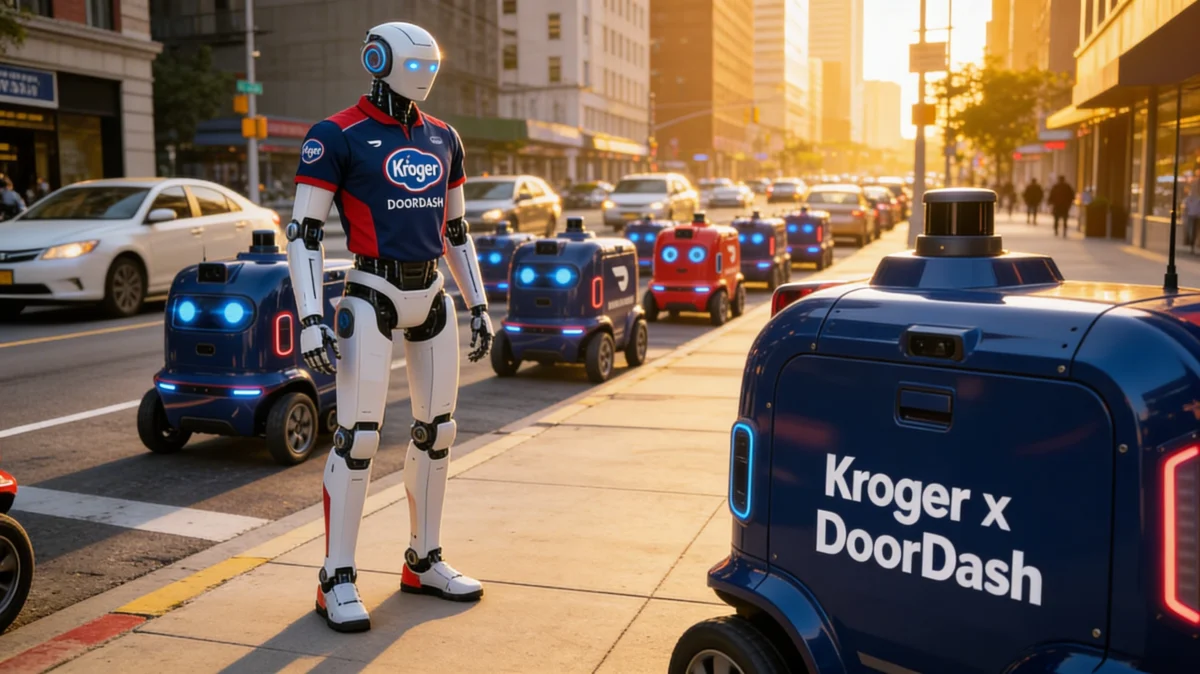
Here is where things get interesting. DoorDash and Kroger recently announced a major expansion of their partnership, bringing the full grocery assortment from nearly 2,700 Kroger stores onto the DoorDash platform for on-demand delivery. That includes banners like Mariano’s, Fred Meyer, Ralphs, and Harris Teeter — making Kroger the largest available grocer on DoorDash and a massive beneficiary of the company’s investment in autonomous delivery infrastructure.
That partnership means Kroger groceries are already flowing through DoorDash’s logistics network — the same network that now includes the Dot robot delivery service. While there has been no specific announcement of a Kroger-plus-Dot pilot, the DoorDash technology infrastructure is in place.
A Kroger order placed through the DoorDash app in a Dot-enabled zone could, in theory, be assigned to the robot by the Autonomous Delivery Platform just like any restaurant order. The same AI dispatcher that routes a burrito from a local taqueria could route a bag of groceries from your nearest Kroger.
For Kroger, this dynamic creates an interesting strategic play. The retailer has invested billions in its own robotic fulfillment and autonomous delivery stack, but DoorDash’s platform gives it something those investments cannot deliver overnight: instant consumer-facing reach, flexible last-mile logistics, and seamless integration into an app that millions of people already use daily.
It is an efficient way to extend delivery hours, reach more customers during demand surges, and fill gaps in coverage without standing up entirely new infrastructure. Whether Kroger eventually deploys Dot-style robots under its own brand — or simply lets DoorDash’s robot delivery service handle the autonomous last mile — remains one of the more intriguing questions in grocery delivery.
Dot vs. Kroger Autonomous Delivery: Side by Side The Bigger Play: Multimodal, All-AI Delivery Networks
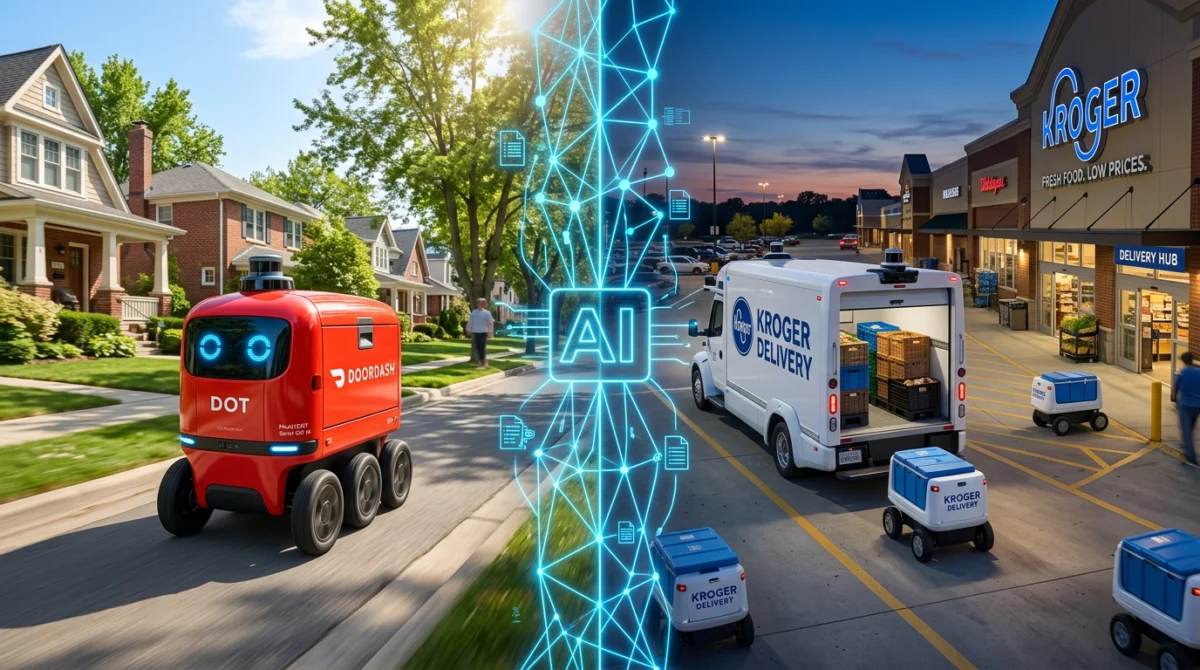
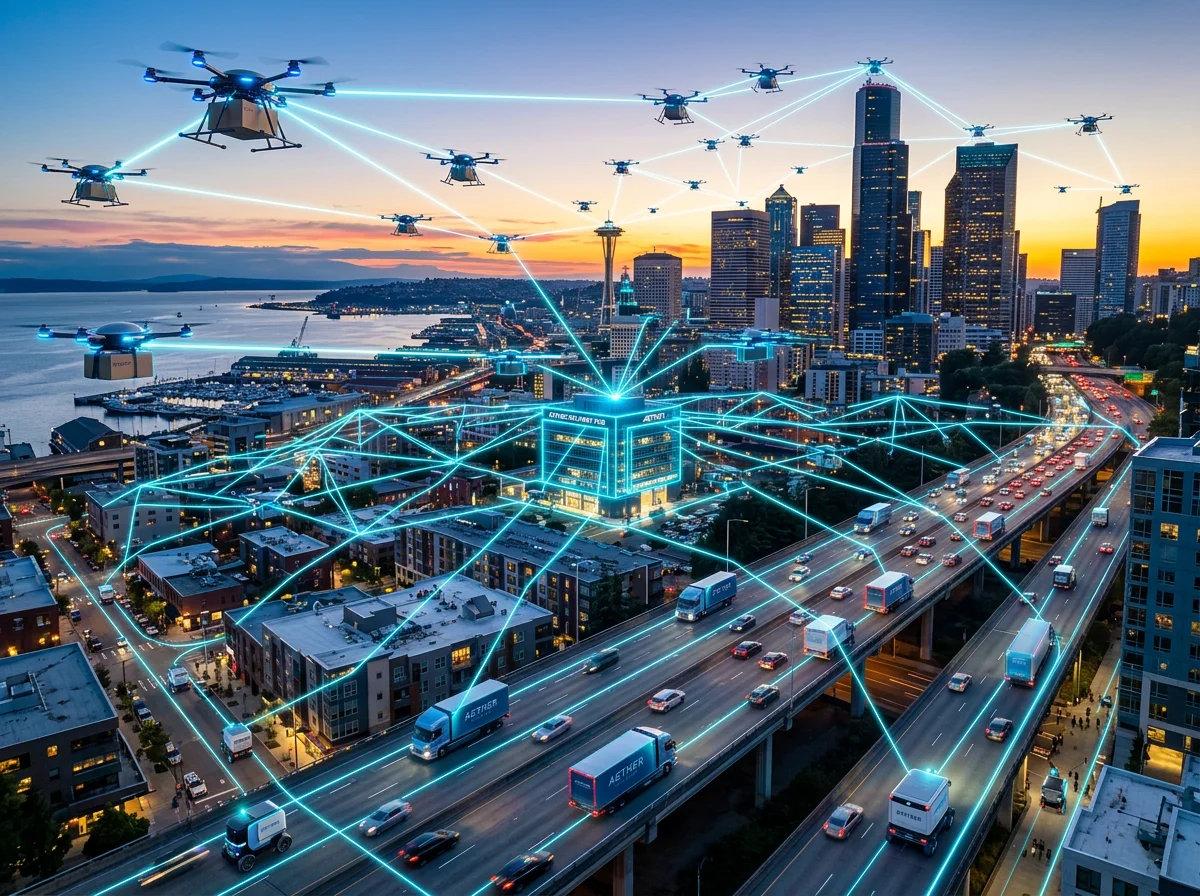
Dot is not the whole story — it is one piece of a much larger puzzle. DoorDash’s Autonomous Delivery Platform is designed from the ground up to be multimodal, meaning it coordinates not just Dot robots but also human Dashers, sidewalk bots from third-party partners, and aerial drones.
The platform functions as a central AI dispatcher — arguably the most consequential piece of DoorDash technology in the entire stack — analyzing every incoming order and matching it with the autonomous delivery method that optimizes speed, cost, distance, and customer experience in real time. This is arguably more significant than any single robot. While some competitors are building standalone delivery bots or standalone drone programs,
DoorDash is building the orchestration layer that ties every robot delivery service and human Dasher together into one unified network. A dense urban order might go to a sidewalk robot.
A suburban order in Phoenix might go to Dot. A lightweight package in a drone-enabled zone might go to a drone. And a complex multi-bag grocery order still goes to a human Dasher in a car. The customer never needs to know or care which mode is used — the app experience is identical regardless of whether a person or a machine delivers the food.
The strategy is clear: own the platform, integrate everything, and let the AI decide the optimal autonomous delivery method for every single order. DoorDash has described this as building “the world’s most comprehensive delivery ecosystem,” and the ambition goes beyond food.
The same DoorDash technology infrastructure that delivers your pad thai tonight could deliver pharmacy prescriptions, convenience-store runs, or retail packages tomorrow. Every delivery — human or robot — makes the platform smarter, faster, and more deeply integrated into the logistics of local commerce.
It is a robot delivery service scaled to the level of genuine infrastructure, and each mile driven feeds the system more data to improve routing, safety, and efficiency across the entire network.
What This Means for Your Next Order
If you are a DoorDash customer, the practical impact of all this DoorDash technology is surprisingly simple: your deliveries should get faster, more reliable, and potentially cheaper over time.
Dot eliminates many of the variables that can slow down or complicate a human delivery — parking, navigation errors, multi-apping, break times — and runs on electricity rather than gasoline, which reduces per-delivery costs as the robot delivery service fleet scales.
For merchants, autonomous delivery means the ability to fulfill orders around the clock without worrying about Dasher availability during slow periods or late-night windows.
DoorDash has stated that delivery fees for Dot orders are the same as they are with a human Dasher — there is no premium or discount for the robot delivery service. You do not choose whether a robot or a person brings your order; the Autonomous Delivery Platform makes that decision based on the specifics of your order, your location, and current network conditions. You might not even notice the difference until Dot shows up at your door with those glowing eyes and that distinctive yawn when it opens its cargo bay.
For merchants, Dot represents a low-friction opportunity powered by DoorDash technology.
The company has emphasized that restaurants and stores of any kind can begin autonomous delivery with Dot at no upfront cost — no new hardware to buy, no separate agreements to sign, and no changes to existing workflow. T
he robot plugs directly into the same merchant tools that already power DoorDash orders. It is designed to feel like just another Dasher pulling up to the counter — except this one never double-parks, never grabs the wrong bag, and never takes a detour to drop off another order on the way.
Final Take: Don’t Freak Out If Your Driver Has LED Eyes
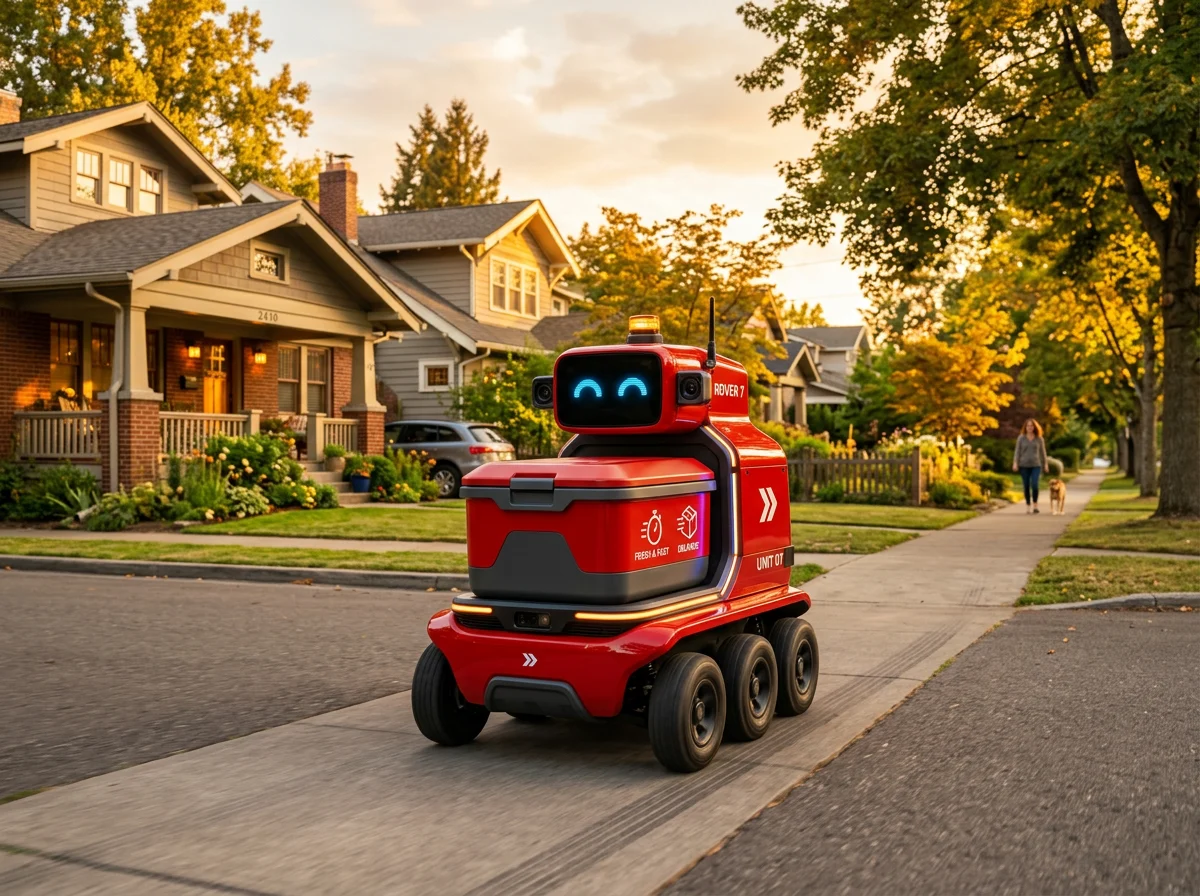
The DoorDash Dot delivery robot is not a gimmick, and it is not going to replace every human delivery driver overnight. What it is, realistically, is the first serious piece of in-house DoorDash technology built for autonomous delivery at scale — a machine designed for the unglamorous, hyper-local deliveries that make up the backbone of the on-demand economy.
It is cute on purpose, efficient by design, and backed by a platform strategy that goes far beyond a single robot rolling down a bike lane in Tempe.
DoorDash is betting that the future of delivery is not one technology — it is all of them, coordinated by AI and deployed at the right moment for the right order. Dot handles the short suburban autonomous delivery runs.
Drones cover the lightweight aerial drops. Sidewalk bots manage dense urban corridors. And human Dashers tackle everything else — the complex, high-value, judgment-heavy deliveries that no robot delivery service can replicate yet. The Autonomous Delivery Platform ties it all together, and every delivery makes the system smarter.
If you are a Dasher, the honest answer is that your world is changing, but slowly and in a way that DoorDash says is designed to complement your work rather than compete with it.
If you are a customer, you will probably enjoy the novelty the first time Dot rolls up to your house — and then quickly forget about it once you realize the robot delivery service experience is basically the same as any other delivery, minus the awkward doorstep eye contact.
And if you are a restaurant, a grocery chain, or a convenience store, the message from DoorDash technology leadership is unmistakable: autonomous delivery is not a pilot program anymore. It is infrastructure. And it is coming to a neighborhood near you — one pair of glowing LED eyes at a time.
| Feature | DoorDash Dot | Kroger Autonomous Delivery |
|---|---|---|
| Builder | Built in-house by DoorDash Labs | Built by third-party robotics partners |
| Vehicle Type | Upright robot, under 5 ft tall, ~350 lbs | Low-profile pod vehicle, no passengers |
| Top Speed | 20 mph | 25 mph |
| Cargo Capacity | Up to 30 lbs (~6 large pizzas) | Full grocery loads, temperature-controlled |
| Operating Environment | Roads, bike lanes, sidewalks, driveways | Public roads |
| Primary Use Case | Restaurant, grocery, and convenience deliveries | Grocery delivery |
| Sensors | Cameras, lidar, radar — 360-degree awareness | Cameras, thermal cameras, radar, lidar |
| Core DoorDash Technology | Fully integrated into the DoorDash app and Autonomous Delivery Platform | Separate third-party systems; Kroger also delivers via DoorDash |
| Pilot Markets | Phoenix metro (Tempe, Mesa), Fremont CA | Houston TX, Scottsdale AZ |
| Feature | DoorDash Dot | Kroger Autonomous Delivery |
| Builder | Built in-house by DoorDash Labs | Built by third-party robotics partners |
| Vehicle Type | Upright robot, under 5 ft tall, ~350 lbs | Low-profile pod vehicle, no passengers |
| Top Speed | 20 mph | 25 mph |
| Cargo Capacity | Up to 30 lbs (~6 large pizzas) | Full grocery loads, temperature-controlled |
| Operating Environment | Roads, bike lanes, sidewalks, driveways | Public roads |
| Primary Use Case | Restaurant, grocery, and convenience deliveries | Grocery delivery |
| Sensors | Cameras, lidar, radar — 360-degree awareness | Cameras, thermal cameras, radar, lidar |
| Core DoorDash Technology | Fully integrated into the DoorDash app and Autonomous Delivery Platform | Separate third-party systems; Kroger also delivers via DoorDash |
| Pilot Markets | Phoenix metro (Tempe, Mesa), Fremont CA | Houston TX, Scottsdale AZ |