


beyond entertainmentChina’s kung fu robots made history at the 2026 Spring Festival Gala — and here is the full story behind the viral performance that shocked the world.
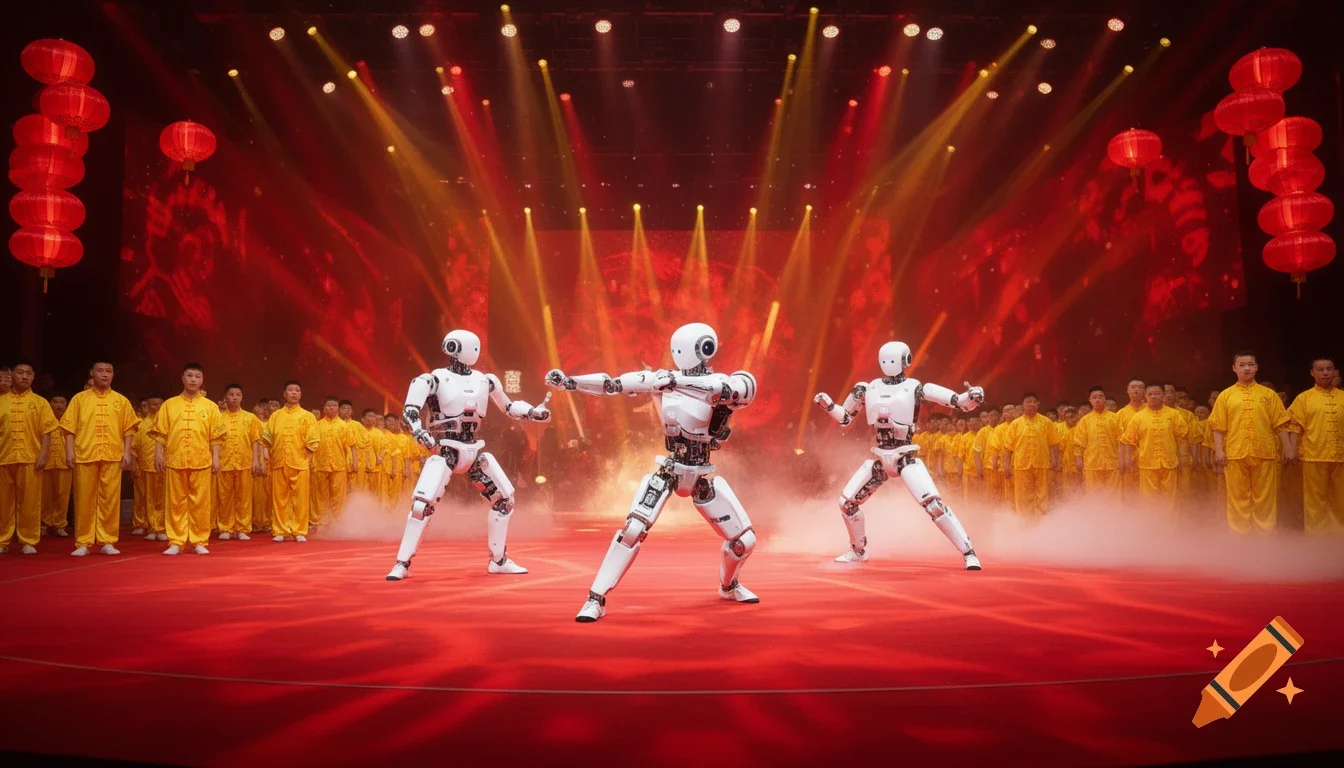
On February 16, 2026, something happened on the world’s most-watched television broadcast that made millions of people stop and stare. During China’s annual Spring Festival Gala — a live event seen by hundreds of millions of viewers — over twenty humanoid robots took the stage alongside children and performed a breathtaking kung fu routine. No remote controls. No operators backstage. Fully autonomous, AI-powered machines executing martial arts with precision, balance, and explosive energy.
The video clips went viral instantly. But beyond the spectacle lies a story that is far more significant — and for some, far more unsettling — than a flashy TV performance. This is the full breakdown of what really happened, who built these robots, and why it matters for the future of artificial intelligence, global technology competition, and robotics.
What Happened at the 2026 Spring Festival Gala?
The performance, titled WuBOT (武BOT), featured robots developed by Unitree Robotics — one of China’s leading humanoid robot manufacturers. The machines performed alongside students from Henan Tagou Martial Arts School, blending ancient kung fu tradition with cutting-edge robotics technology in front of a live global audience.
What stunned viewers worldwide was not just that robots were dancing — it was how they were doing it:
- Consecutive single-leg backflips with fluid continuity
- High-difficulty aerial jumps launching 2–3 meters high from a custom platform
- Rapid formation changes — over twenty robots switching patterns at speed while performing martial arts moves simultaneously
- Stick fighting and drunken boxing routines, including a scripted moment where a robot “collapsed drunkenly” then snapped back up in a swift carp flip
- Nunchuk twirling, high kicks, and synchronized spins timed to music down to the tenth of a second
Unitree’s lead engineer Wang Xingxing told CCTV News: “We wanted the robots to push their limits on the Gala stage.” That mission was accomplished in spectacular fashion.


Meet the Unitree G1: The Robot Behind the Viral Moment
The stars of the WuBOT performance were the Unitree G1 humanoid robots — compact, agile machines that have rapidly evolved over the past 12 months. Here’s what makes the G1 so remarkable:
- Fully autonomous operation — onboard AI handles all movement decisions in real time
- Swarm intelligence — over twenty G1 units coordinated with each other throughout the performance without a central controller
- Dexterous hands — capable of catching and spinning sticks, a feature added specifically for the WuBOT show
- Adaptive balance — robots maintained stability on a live stage with varying terrain and lighting conditions
Just one year earlier, these robots could barely wave their arms on stage. The leap in capability in just twelve months has left robotics experts worldwide both impressed and alarmed. A previous Unitree stage performance in late 2025 went viral and even drew public praise from Elon Musk, sending the company’s global profile skyrocketing before the Spring Festival appearance.
Learn more about how AI tools are reshaping industries beyond entertainment.
The “Terrifying Truth” — Why Experts Are Paying Close Attention
For casual viewers, this was an incredible piece of entertainment. For technology analysts, defense researchers, and AI experts, it was a clear signal of something much bigger. Here’s why:
1. Fully Autonomous Swarm Control — A World First
The high-speed formation switching of more than twenty robots on stage was not a pre-programmed puppet show. It represented a global debut of high-dynamic, high-coordination swarm control technology. Unitree team member Lian Yingying explained that synchronizing over twenty robots perfectly with music, human performers, and changing stage terrain required timing precision down to one-tenth of a second.
The real-world applications of swarm robotics extend far beyond entertainment — logistics warehouses, search-and-rescue operations, construction, and yes, military applications have all been discussed in academic and defense circles.
2. Speed of Development Is Unprecedented
The 2025 Spring Festival Gala featured Unitree robots changing formations by “walking slowly.” One year later, they were running, flipping, and fighting. That rate of improvement has drawn comparisons to the early days of the smartphone revolution — except this time, the hardware is physical, autonomous, and humanoid.
China’s investment in robotics technology has been driven by national strategy, with the Chinese government explicitly naming humanoid robots as a key sector in its industrial development plans through 2030.
3. Public Perception as a Strategic Tool
The Spring Festival Gala is not just entertainment — it is a national cultural institution watched by hundreds of millions of Chinese citizens and rebroadcast globally. Showcasing humanoid robots performing Chinese kung fu on this stage sends a carefully crafted message both domestically and internationally: China is leading the humanoid robotics race.
Wang Xingxing captured it plainly: “Through the most advanced AI technology embodied in humanoid robots, Chinese kung fu can reach the world more effectively.”

The Companies Behind the Robots
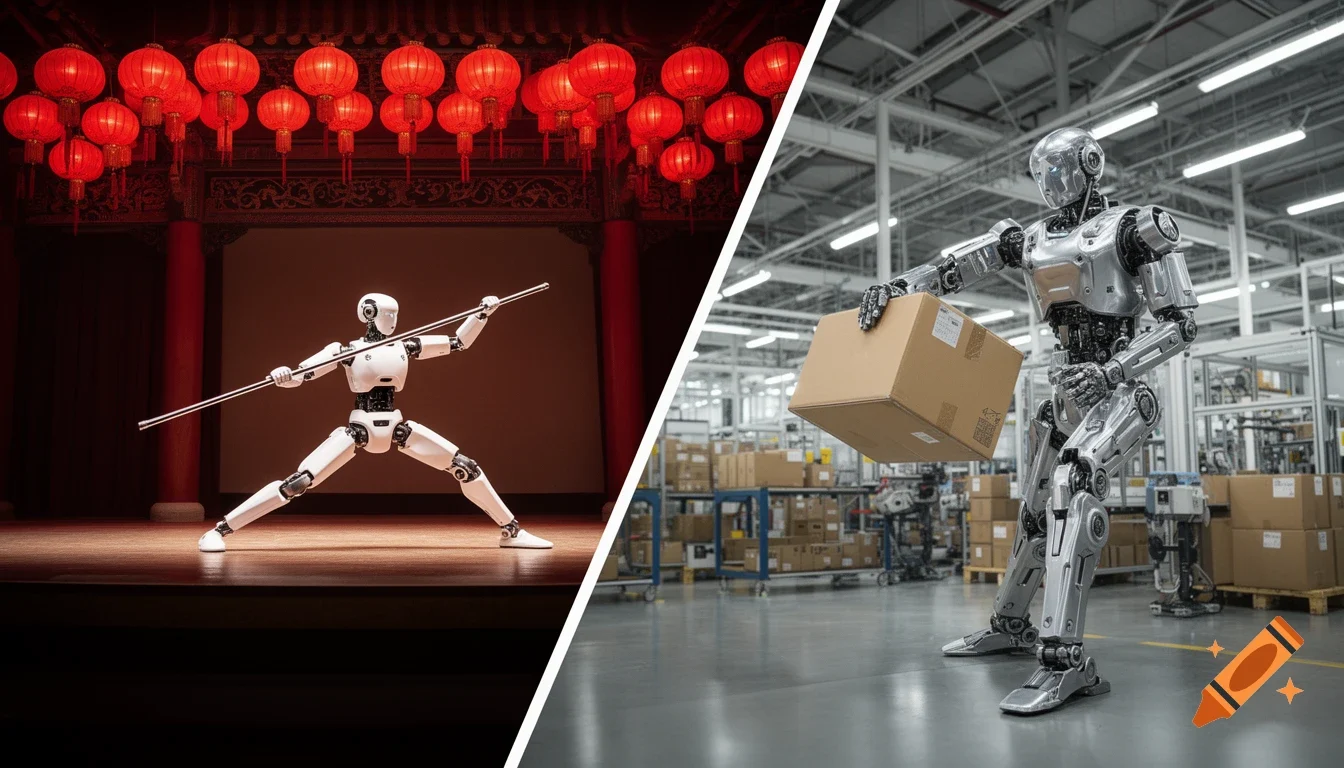
While Unitree Robotics stole the spotlight with the WuBOT performance, four companies in total participated in the 2026 Spring Festival Gala robotics showcase:
- Unitree Robotics — WuBOT kung fu performance, G1 and H2 robots
- MagicLab — contributed robots and approximately £6 million for participation
- Galbot — contributed robots and approximately £6 million for participation
- Noetix — contributed robots and approximately £6 million for participation
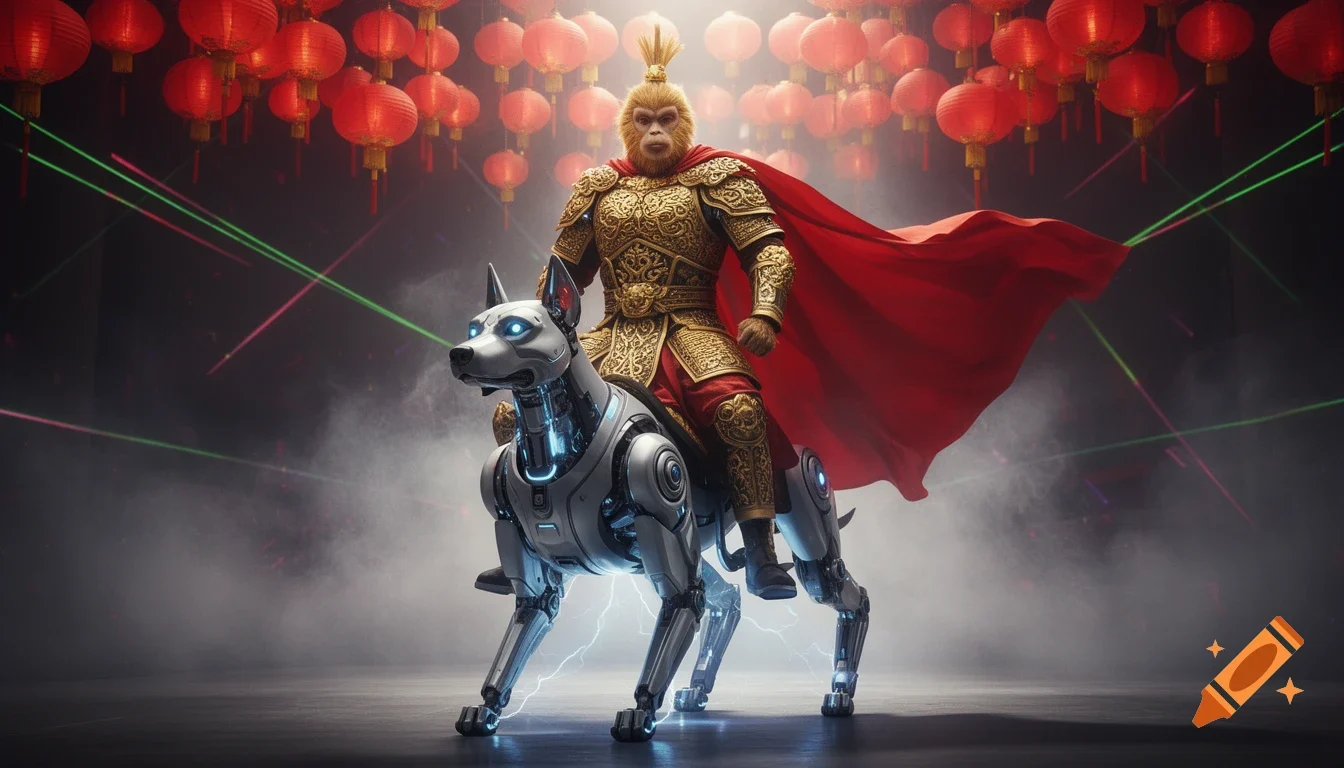
The H2 robot — a larger Unitree model — made a symbolic appearance portraying the Monkey King delivering New Year greetings at both the main Beijing venue and the Yiwu sub-venue. Due to its sword prop, the H2 was kept at a distance from the child performers — a sign that safety protocols remain a priority even as capabilities advance rapidly.
How Did They Pull It Off? The Behind-the-Scenes Story
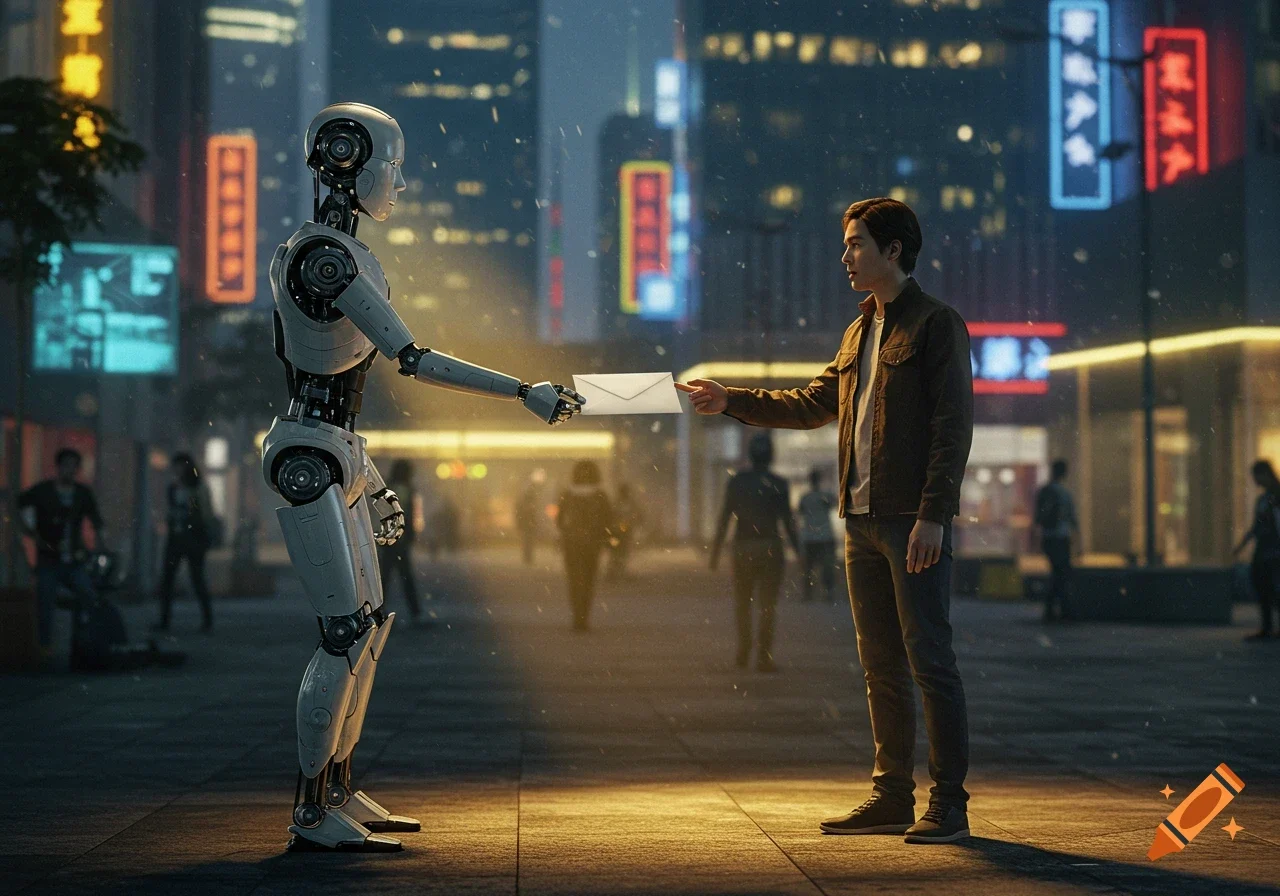
What looked effortless on screen was the result of months of meticulous preparation. Unitree released behind-the-scenes footage showing the G1 robots going through extensive rehearsals — practicing choreography, adjusting timing, and stress-testing movements under real stage conditions.
Key engineering challenges the team solved:
- Custom launch platform for backflips — allowing robots to jump 2–3 meters and complete front and side flips before landing steadily
- Timing calibration — each movement refined to one-tenth of a second to sync with music and human co-performers
- Environmental adaptation — robots had to maintain balance on a live stage with changing surfaces, lights, and real-time conditions
- Swarm communication — real-time coordination between 20+ autonomous robots without any central controller or joystick input
Director Chi Yuhan described the concept as a “future martial arts academy” — a vision where robots and humans train and perform together, each pushing the other to new limits.
What the Human Performers Thought
For the students of Henan Tagou Martial Arts School, the experience was unforgettable. Eleven-year-old Fu, one of the young performers, described sparring with robots as “novel and exhilarating” — like training with senior disciples that boosted fighting spirit.
The human element is important to understand. This performance was not robots replacing humans — it was robots alongside humans, amplifying the spectacle. But as capabilities continue to advance, that balance will shift.
Global Reaction: Shock, Awe, and Debate
The performance dominated Chinese social media and ignited global debate. Reactions ranged from genuine amazement to concern about the pace of autonomous robotics development. Bloomberg Television covered the story noting that the performance “sparked mixed reactions and debate over the future of robotics in entertainment.”
Key points driving the global conversation:
- This was live, real-time, autonomous performance on one of the world’s biggest stages — not a lab demo
- The speed of year-over-year improvement in Unitree’s robots is alarming many in the tech community
- The dual-use nature of swarm coordination technology raises questions in defense and security circles
- Western media have been catching up slowly to the significance of China’s robotics achievements
Interested in how AI is revolutionizing the workplace and what skills you need to stay ahead? Read our deep dive.
What This Means for the Future of Humanoid Robotics
The WuBOT performance at the 2026 Spring Festival Gala is a milestone moment — not just for Chinese robotics, but for the entire field of humanoid AI. Here is what industry observers are watching next:
Near-Term Applications (2026–2028)
- Deployment of humanoid robots in manufacturing and logistics at scale
- Expansion into entertainment, hospitality, and service industries
- Continued improvement in swarm coordination for multi-robot task execution
Medium-Term Implications (2028–2032)
- Humanoid robots becoming a mainstream labor force supplement in Asia
- Significant geopolitical competition between China and the US in humanoid AI development
- New regulatory frameworks needed for autonomous robot deployment in public spaces
The question is no longer whether humanoid robots will transform society — it’s how fast.
Key Takeaways
- China’s 2026 Spring Festival Gala featured 20+ fully autonomous Unitree G1 robots performing kung fu live in front of hundreds of millions of viewers
- The performance showcased world-first swarm control technology with no remote operators or joysticks involved
- Unitree Robotics — backed by national strategic investment — advanced from slow walking robots to backflipping, nunchuk-twirling machines in just 12 months
- The dual-use potential of this technology has significant implications for global defense, labor markets, and AI competition
- This is not entertainment hype — it is a genuine technological inflection point the world needs to understand
Frequently Asked Questions
What robots performed at the 2026 Spring Festival Gala?
The primary robots were the Unitree G1 humanoid robots, developed by Unitree Robotics. A larger model, the H2, also appeared in a symbolic role as the Monkey King. Robots from MagicLab, Galbot, and Noetix also participated in the broader showcase.
Were the kung fu robots remote controlled?
No. Every robot in the WuBOT performance operated fully autonomously using onboard AI. There were no remote controls or backstage operators. Each G1 coordinated with the others through swarm intelligence technology.
Why is China’s kung fu robot performance significant?
Beyond the spectacle, the performance demonstrated a real-world debut of high-dynamic swarm coordination technology — twenty autonomous robots operating together in real time. The speed of advancement, national strategic backing, and dual-use potential of this technology make it a genuine milestone in global robotics and AI development.
Who made the robots at the Spring Festival Gala?
Unitree Robotics was the primary developer, responsible for the WuBOT kung fu performance. The company is based in China and is considered one of the world’s leading humanoid robotics manufacturers. Three other companies — MagicLab, Galbot, and Noetix — also contributed robots to the 2026 Gala.
Want to stay ahead of the AI and robotics curve? Explore more on RodRice.org’s AI section and Technology hub.
Learn More About China’s Kung Fu Robots and Humanoid AI
China’s kung fu robots have sparked global conversation. The 2026 Spring Festival Gala performance by Unitree Robotics set a new benchmark for humanoid AI capabilities. For more on the event, read the detailed analysis at Geopolitechs, or watch the official CCTV video footage.
These kung fu robots represent a landmark in China’s rapidly advancing robotics industry. The Spring Festival Gala gave kung fu robots a global stage, and the world is now watching what comes next from Unitree and China’s humanoid robot ecosystem.